Your website should end in an appointment: how to design for bookings
Brand · 2026-09-24 · 6 min · Hi Marky
Salons, clinics and studios live by their calendar. Four design decisions that turn visits into bookings.
In short
- In a service business the site has one job: getting someone to book. Every section should end in a next step.
- Visible price and duration remove the uncertainty, which is what really drives people away.
- The test is simple: a stranger should be able to book from their phone in under a minute.
There's a simple test for any service website. Hand your phone to someone who doesn't know the business and ask them one thing: book an appointment. Then count the seconds. Far too often the person scrolls through beautiful photos, reads an inspiring phrase, gets to the bottom and asks where to book.
For a salon, a clinic, a studio or a workshop, the website has a single job, and it's getting someone to book. It can be gorgeous, tell a story and win awards; if the person reaches the end without knowing how to book, it failed. These are the design decisions that turn visits into appointments, with two cases of sites we built with exactly that in mind.
The button that doesn't go away
Many service sites look like a magazine. Big photos, polished copy and a contact button hidden in the menu. Visitors enjoy the ride and leave, because nobody told them what to do next. Designing for bookings isn't giving up on aesthetics. It's giving every part a clear way out.
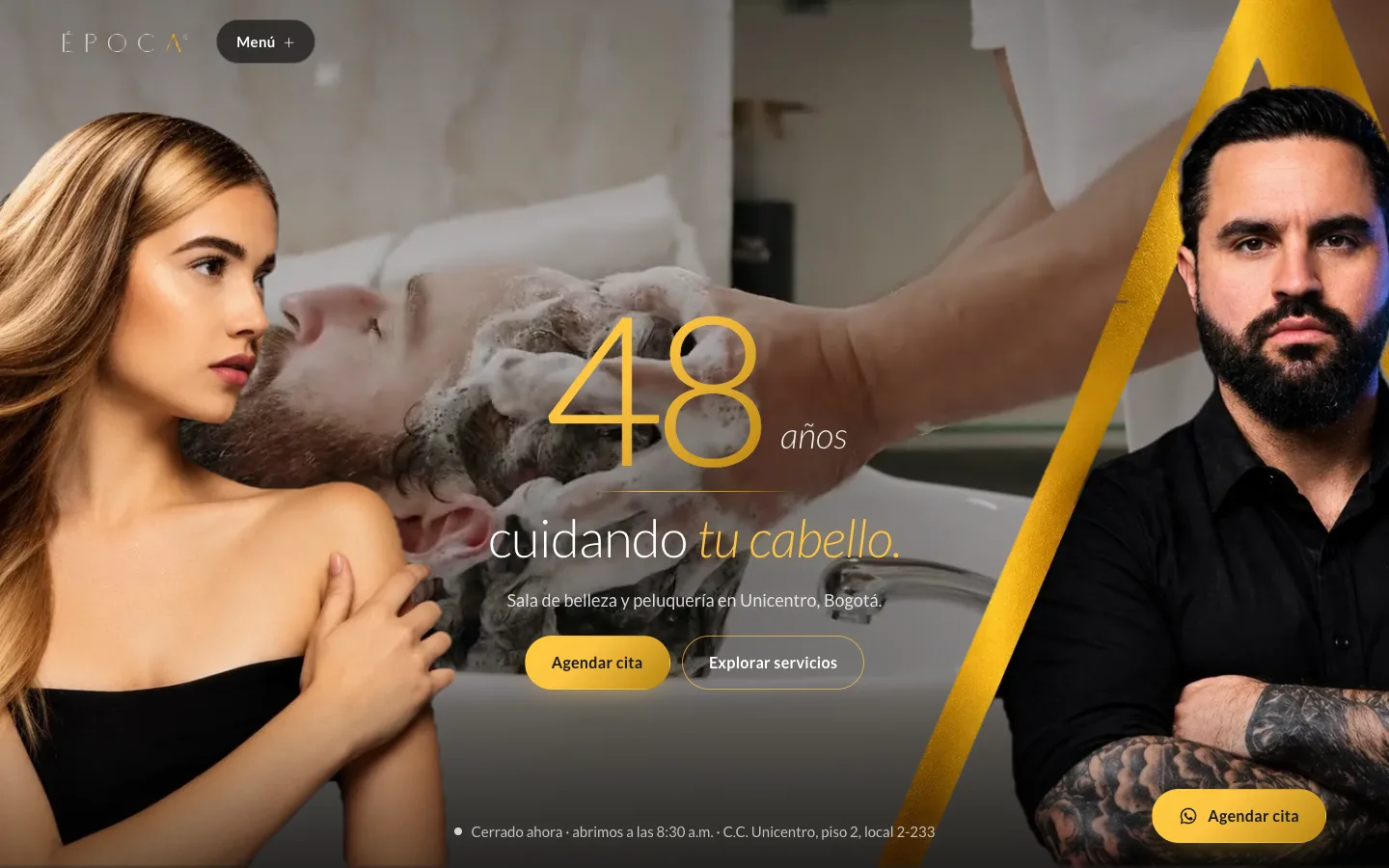
On the site of Época, a beauty salon with 48 years of history at Unicentro Bogotá, the booking button accompanies the whole journey. It stays visible as the person scrolls, without forcing them back to the top. On mobile there are three fixed shortcuts at the bottom, right where the thumb lands: WhatsApp, call and directions.
The rule that follows is that every section ends in an action. After telling the story, after showing the services, after introducing the team, there's always a next step. It doesn't have to be "book" every time. It can be see prices, meet the team or look at results. What matters is that the person is never left without knowing where to go next, because a section that ends in nothing is an exit door.
Price, duration and the customer's language
People don't book what they don't understand. How much it costs and how long it takes are the two questions that precede any appointment, and answering them on the page saves repeated messages and filters out people who aren't your customers. If the price depends on an assessment, say so and offer a range or a "from" price.
What drives people away isn't the price. It's the uncertainty.
The other obstacle is language. A specialized service is poorly explained when the expert describes it in their own words. On the site of Panamericana de Odontólogos, every specialty is written in patient language: what problem it solves, what the process is like and what to expect. The assessment button accompanies the whole journey and goes straight to WhatsApp. The rule works for any trade: describe the result the person wants, not the technique you've mastered.
History and people as a reason to choose you
A business with a track record often hides it for fear of looking old. Told well, it's exactly what sets it apart from whoever opened six months ago. At Época the 48 years are the thread of the whole page. They don't appear as a boring timeline but as an editorial piece in black and gold where tradition becomes a reason to trust.
The same goes for the team. In a service, people buy from people, and real photos of those who serve, with name and specialty, build more trust than any phrase about highly qualified professionals. If your customers ask for appointments with someone in particular, they should be able to choose them from the site.
Add social proof: reviews with names, photos of results with permission, the Google rating in view. Its best place is near the booking button, which is where the doubt appears.
WhatsApp, online booking and forms
There's no single answer about the channel. WhatsApp is natural for Colombian customers and lets them clear up doubts before booking, but it requires someone to answer fast. Online booking lets people book at any hour without intervention and works best when services have a fixed duration and price. Many businesses combine both: booking for the standard and WhatsApp for what needs an assessment.
Whichever it is, one detail helps a lot. The opening message should come pre-filled with the service the person was viewing. It saves them a step and tells your team what it's about before they open the chat.
If you use a form, ask for the minimum: name, phone and service. Every additional field reduces bookings. The rest is asked later, once the person has taken the first step.
Mobile, Google and what happens afterward
Most bookings are made from a phone, often arriving from a social network. The site has to load fast, be readable without zooming and allow booking with one hand. The way to check is to open the link from Instagram, on mobile data, and try to book in under a minute.
A site that converts well but nobody visits is of little use. For a local business that means having one page per service, the city and area written in the text and an up-to-date Google Business Profile. That's how you show up when someone searches for the service nearby.
The appointment doesn't end when the customer leaves. A reminder the day before reduces no-shows. The review is requested while the person is happy, and it's the most convincing content your site can have, as well as one of the factors that weighs most on Google for a neighborhood business. And offering the next visit before they leave fills next month's calendar.
To know where the problem is, a few numbers are enough: clicks on the booking button, clicks on WhatsApp and call, which page gets the most bookings, how many conversations end in an appointment and how many appointments are kept. With that you can tell whether the site, the service or simply the traffic is failing.